
AI models are becoming remarkably capable.
They can write articles, generate code, analyze documents, create images, summarize research, and answer complex questions.
So why do AI companies still need humans to train and evaluate these systems?
The simple answer is that AI can generate an answer, but humans still need to determine whether that answer is actually good.
Human experts help AI systems become more accurate, useful, relevant, and aligned with what people expect.
Table of Contents
Why Does AI Need Human Feedback?
An AI model can produce an answer that looks convincing but is still wrong.
It might:
- Make a factual error
- Misunderstand the question
- Miss an important detail
- Follow the wrong instruction
- Give an incomplete answer
- Use incorrect reasoning
- Provide outdated information
- Produce a technically correct but impractical solution
A model doesn’t automatically know which of these problems matter most.
Human feedback provides an additional signal.
For example, imagine an AI produces two answers to the same question.
Response A is technically correct but difficult to understand.
Response B is accurate, clear, and directly answers the question.
A human evaluator can identify that Response B is more useful.
That type of judgment can become valuable training or evaluation data.
AI Doesn’t Automatically Know What a “Good” Answer Looks Like
This is one of the biggest reasons humans remain important.
Consider a simple question:
“Explain inflation to a 10-year-old.”
An AI might produce a technically accurate explanation containing complex economic terminology.
Another response might explain the same concept using a simple example that a child can understand.
Both responses could contain correct information.
But which one better follows the instruction?
A human can make that judgment.
This is particularly important when AI systems are evaluated for qualities such as:
- Accuracy
- Clarity
- Relevance
- Helpfulness
- Completeness
- Instruction following
- Reasoning quality
These qualities are not always easy to measure with a simple automated test.
Human Experts Bring Domain Knowledge
Not every AI question has a simple right or wrong answer.
Consider a medical question.
A general evaluator may be able to identify obvious mistakes, but a medical professional may notice a subtle problem that someone without medical training could miss.
The same applies to other fields.
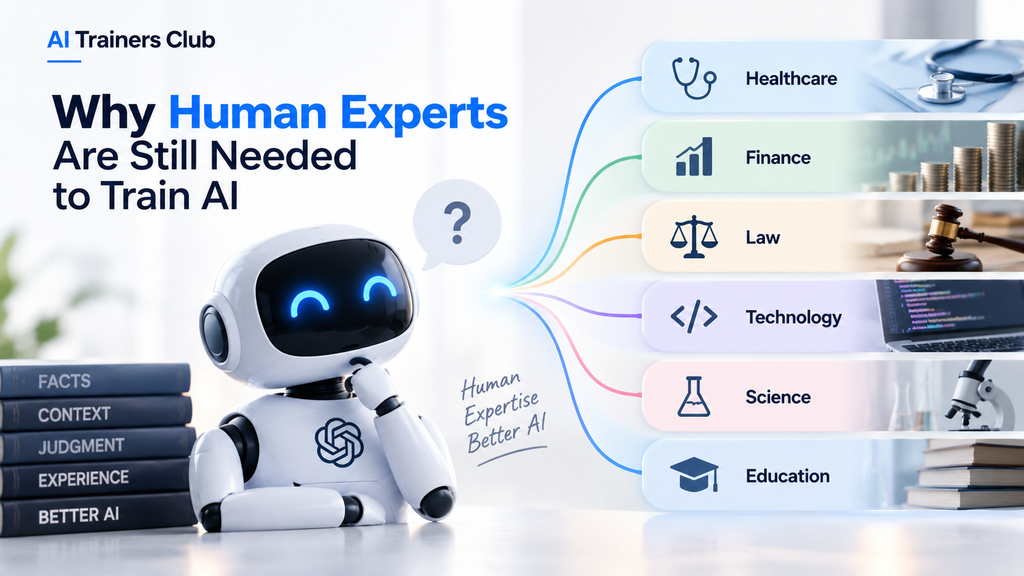
Finance
A finance professional can evaluate whether an AI-generated financial analysis makes sense.
Programming
A developer can identify subtle problems in generated code.
Law
A legal professional can evaluate whether an argument correctly applies a particular legal principle.
Healthcare
A healthcare professional can identify potentially important inaccuracies in medical information.
Science
A scientist can evaluate whether an explanation is consistent with current evidence.
This is why domain expertise can become extremely valuable in AI evaluation and training.
AI companies are increasingly building evaluations around realistic professional tasks rather than relying only on simple academic questions.
AI Training Is More Than Labeling Data
Human involvement in AI can take many forms.
An AI trainer or evaluator might be asked to:
- Compare two AI responses
- Correct an incorrect answer
- Write an ideal response
- Evaluate an AI-generated explanation
- Check reasoning
- Review generated code
- Identify factual errors
- Rate responses against a rubric
- Test whether an AI follows instructions
- Evaluate specialist knowledge
Some of these tasks require very little technical knowledge.
Others require significant expertise.
This is why the term AI trainer can cover a surprisingly broad range of work.
Why AI Evaluation Is Becoming More Difficult
There is an interesting problem with increasingly capable AI.
As models improve, their mistakes can become harder to detect.
A weak model may produce an obviously incorrect answer.
A stronger model may produce an answer that looks polished and convincing while containing a subtle error.
That makes evaluation more important.
It also makes expert evaluation more difficult.
For example, evaluating a simple arithmetic answer may be straightforward.
Evaluating whether an AI has produced a good scientific research proposal is much more complicated.
You may need to consider:
- Scientific accuracy
- Quality of evidence
- Assumptions
- Methodology
- Practical feasibility
- Missing information
- Potential limitations
A human expert can bring context that a simple automated test may miss.
Can AI Evaluate Other AI?
Yes.
AI systems can increasingly be used as automated graders or evaluators.
For example, an AI model can be instructed to score another model’s response against a set of criteria.
This can make evaluation much faster.
But automated evaluation has limitations.
An AI grader can also make mistakes.
It may misunderstand the rubric, overlook an error, or prefer a response for the wrong reason.
This creates a useful combination:
AI evaluates → humans audit → problems are identified → evaluation improves
Human oversight can therefore remain important even when AI is being used to assist with evaluation.
Why Human Experts Are Especially Important for Complex Tasks
Simple tasks are easier to automate.
Suppose an AI needs to classify an image as:
Cat / Dog / Horse
That can potentially be handled with relatively straightforward labeling.
Now consider:
“Evaluate whether this medical research proposal has a scientifically sound methodology.”
That is a very different problem.
The evaluator may need to understand:
- The research question
- Existing evidence
- Study design
- Statistical reasoning
- Potential limitations
- Domain-specific terminology
The more complicated the task becomes, the more valuable specialized knowledge can become.
Human Feedback Can Improve AI Models
Human feedback isn’t only useful for evaluating models.
It can also be used during model improvement.
A simplified process looks like this:
AI generates an answer
↓
Human evaluates the answer
↓
Human identifies strengths and weaknesses
↓
Feedback becomes training or evaluation data
↓
Model is improved
↓
New version is evaluated again
This process can be repeated many times.
One well-known approach is Reinforcement Learning from Human Feedback (RLHF), where human preferences are used as part of the process of improving model behavior.
The Role of Experts Is Changing
Human experts aren’t necessarily going to disappear from AI training as models become more capable.
Their role may change.
Instead of manually reviewing every simple output, experts may increasingly focus on:
- Difficult cases
- Ambiguous questions
- High-risk applications
- Complex reasoning
- Specialist knowledge
- Evaluation design
- Quality control
- Auditing automated evaluation
In other words, AI can help humans perform more evaluation, while humans continue to provide judgment where it matters most.
What Skills Are Useful for AI Training?
You don’t necessarily need to be an AI engineer.
Depending on the project, useful skills can include:
Critical thinking
Can you identify weaknesses in an argument or answer?
Attention to detail
Can you spot a small but important error?
Writing
Can you explain what a better answer should look like?
Research
Can you verify whether information is accurate?
Domain expertise
Do you have professional knowledge in a particular field?
Following instructions
Can you consistently apply a detailed evaluation rubric?
Communication
Can you clearly explain why one response is better than another?
These skills can be useful across many different AI training and evaluation tasks.
Why Domain Experts May Become More Important
AI models are increasingly being used for specialized work.
That creates a need for evaluations that reflect real-world expertise.
A general AI benchmark might ask a model a factual question.
A professional evaluation might instead ask the model to complete a realistic task that someone in that profession would actually perform.
The second approach can reveal problems that a traditional benchmark may not capture.
For example, an AI might know the definition of a financial concept but still produce a poor financial analysis.
It might know medical terminology but misunderstand a clinical scenario.
It might write syntactically correct code that doesn’t work correctly in a real application.
Knowing information is not the same as applying it correctly.
Human experts can help test that difference.
Will AI Replace Human AI Trainers?
It’s too early to assume that one approach will completely replace the other.
AI is already being used to automate parts of data labeling, grading, evaluation, and quality control.
At the same time, humans remain important for tasks where judgment, expertise, context, or nuanced evaluation is required.
The more likely direction is a combination of humans and AI.
AI can handle large volumes of relatively straightforward work.
Humans can focus on difficult, ambiguous, and high-value cases.
Frequently Asked Questions
Why do AI models need human trainers?
Humans provide feedback that helps identify errors, evaluate quality, demonstrate preferred responses, and determine whether an AI system is behaving as intended.
Do AI trainers need to know programming?
Not necessarily. Some projects require programming expertise, while others focus on writing, reasoning, research, language, or specialist knowledge.
Why are domain experts important in AI training?
Domain experts can identify errors and weaknesses that general evaluators may not recognize, particularly in specialized areas such as medicine, finance, law, science, and engineering.
Can AI train other AI models?
AI can assist with parts of the training and evaluation process, including automated grading and feedback. However, human oversight can still be important for checking the quality of those automated judgments.
What is the difference between an AI trainer and an AI evaluator?
The terms can overlap. An AI trainer may provide feedback or examples used to improve a model, while an AI evaluator generally focuses on measuring and assessing model performance.
Final Thoughts
AI models are becoming more capable, but capability alone doesn’t solve the problem of determining whether an AI response is correct, useful, appropriate, and relevant.
That’s where humans continue to play an important role.
The future of AI training is unlikely to be simply humans versus AI.
Instead, it may increasingly be:
AI handles scale. Humans provide judgment.
And as AI moves into increasingly specialized areas, people with genuine expertise in fields such as healthcare, finance, law, science, education, and technology may have an increasingly important role in helping AI systems perform those tasks correctly.
At AI Trainers Club, we’ll continue exploring how humans and AI work together to build, evaluate, and improve the next generation of AI systems.
Leave a Reply