
You find a remote AI training job that matches your skills. The pay looks good, the hours are flexible, and the application takes only a few minutes.
Then you reach the eligibility section and discover that the company only accepts applicants from three countries.
It’s a familiar frustration for people searching for AI training work outside the United States.
The problem is that remote, global, and available in your country are not interchangeable. A company might recruit contractors internationally but restrict one project to US residents.
Another might accept your application yet be unable to pay you in your country, and sometimes the obstacle is a professional licence, language requirement, or identity check rather than your location alone.
If you’re applying from India, the Philippines, Nigeria, Kenya, South Africa, or anywhere else, a little research before taking an assessment can save hours of wasted effort.
Table of Contents
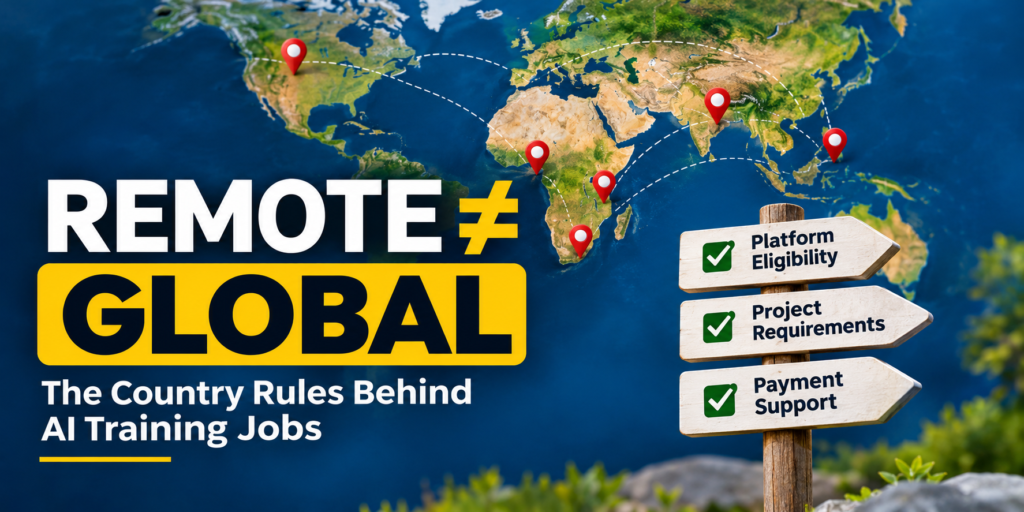
Three country checks that decide whether you can actually work
A listing described as remote only tells you where the work is performed. It does not necessarily tell you who can apply.
Platform eligibility comes first. The company needs to support contractors who genuinely live in your country. Some publish a list of supported regions; others publish exclusions.
Project eligibility is narrower. A client can require contributors from a particular country, state, or region even when the wider platform operates internationally.
Payment eligibility is a separate issue. You may need a supported bank account, identity verification, and tax details before the company can release money. For a project with unpaid screening, it is worth checking this before you start.
Here is the distinction in practice:
| Label on the opportunity | What it actually tells you |
|---|---|
| Remote | You can generally work away from a physical office, subject to geographic rules |
| Worldwide or global | The role invites an international applicant pool, but exclusions and screening can still apply |
| US only | Residency or other US-specific requirements apply |
| US, UK and Canada | Applications are limited to those stated countries |
| Available on the platform | You can access or register on the platform, but a specific paid project is not guaranteed |
The international eligibility comparison
I checked publicly available company policies on November 4, 2026. The table below focuses on five applicant countries that frequently appear in discussions about remote AI work.
| Country | Outlier | Mercor | micro1 | AfterQuery |
|---|---|---|---|---|
| India | Listed | Listed | Not excluded | Supported |
| Philippines | Listed | Listed | Not excluded | Supported |
| Nigeria | Not listed | Listed | Not excluded | Unsupported |
| Kenya | Not listed | Not listed | Not excluded | Supported |
| South Africa | Listed | Listed | Not excluded | Supported |
How to read this table: “Listed” means the country appears in a platform’s published supported-location policy. “Not listed” means it does not appear in that policy, so do not assume you can register or work there. “Not excluded” reflects micro1’s published global hiring statement and exclusions; it does not mean a specific project will accept you. The AfterQuery column describes bank-payout support, not a general promise of hiring eligibility.
You can check the original policies: Outlier’s flexible working guidelines, Mercor’s supported countries, micro1’s expert FAQ, and AfterQuery’s payment-country list.
These lists can change. Always recheck the applicable policy and the actual opportunity before submitting documents or completing lengthy assessments.
Where each platform draws the line
Outlier: broad coverage, with project-specific limits
Outlier publishes a detailed country list in its flexible working guidelines. India, the Philippines, and South Africa appear on that list. Nigeria and Kenya do not appear on the version reviewed for this article.
But inclusion isn’t a universal invitation. The policy explicitly says some customers require contributors from specific countries or regions. A general writing opportunity and a highly specialized technical assignment may therefore have completely different geographic requirements.
The company also verifies contributors’ identity and primary location. If you move, you may need to update that location and verify again. Its guidelines prohibit using a VPN to conceal your presence in a restricted country.
Best approach: Check both the country policy and the location shown on the individual opportunity. Treat access to the platform as the first step, not confirmation of paid work.
Mercor: a supported country doesn’t guarantee a suitable contract
Mercor publishes a supported-regions list and states that it does not engage contractors in countries outside it. India, Nigeria, the Philippines, and South Africa are included. Kenya is not currently on that published list.
Even within supported countries, clients can set their own requirements. Some engagements recruit professionals internationally. Others need people in the US, UK, or Canada, or require particular credentials and work experience.
This is especially important for expert projects. A remote role requiring a professional licence in one country is not automatically available to a qualified specialist living somewhere else.
If you’re considering the platform, our Mercor review covers its screening process, contracts, and payment arrangements.
micro1: global recruitment with published exclusions
micro1 says it hires expertise from around the world. Its published list of excluded countries and regions does not include India, the Philippines, Nigeria, Kenya, or South Africa.
That makes it worth examining for qualified applicants in those countries. But there is a second gate: candidates still need to match the particular role’s requirements and complete the relevant screening or certification. The company’s FAQ states that certification does not guarantee immediate placement.
Pay attention to the distinction between a broad global recruitment policy and one client’s actual hiring brief. A worldwide specialist project may ask for advanced experience in law, finance, software, medicine, or another field.
AfterQuery: verify payment support before anything else
AfterQuery provides an unusually useful list of countries where its Stripe payouts are supported. India, Kenya, the Philippines, and South Africa appear on its supported payment-country list. Nigeria is explicitly listed as unsupported.
This is a payment list, not a public guarantee that every supported country has an available project. Individual screening and project selection still apply.
The payment documentation also says your registered country, bank-account country, and legal name must agree. A mismatch can delay payouts. It currently identifies Stripe as the payment method, with Wise described as a plan rather than an available alternative.
Our AfterQuery review looks more closely at assessments, task approvals, and payments.
Terac: eligibility can change from one study to the next
Terac uses opportunity-level filters. Its documentation says researchers can filter candidates by country of residence, country detected from an IP address, state, and city. People who don’t match the filters may never see a particular opportunity in their feed.
That means an empty list of opportunities doesn’t automatically mean the platform has stopped recruiting in your country. It may simply have no studies matching your location and professional profile at that moment.
Payment support also needs checking. Terac says it uses Whop for payouts, with Virtual Incentives used in some countries where Whop cannot pay. It advises contributors to check their Earnings page for the methods available to them.
See our Terac review for more on its application and payment process.
A practical country-by-country starting point
For India, Outlier and Mercor list the country, micro1 does not exclude it, and AfterQuery supports Stripe payouts there. Terac requires a separate check of each opportunity and payout method. Don’t assume that globally advertised hourly rates are the same for Indian contributors.
For the Philippines, Outlier and Mercor include the country, micro1 does not exclude it, and AfterQuery lists it for payouts. Terac opportunities still need to be checked individually. Skills, language requirements, and the restrictions of particular assignments remain decisive.
For Nigeria, Mercor is on the supported-country list, while micro1 does not exclude Nigeria in its published global hiring policy. By contrast, Nigeria is absent from Outlier’s supported working-location list and appears in AfterQuery’s unsupported payout countries.
For Kenya, micro1 does not exclude the country, and AfterQuery lists Kenya for Stripe payouts. Kenya does not appear on the current working-location lists for Outlier or Mercor. Payout support alone does not establish availability of AfterQuery assignments.
For South Africa, Outlier and Mercor include the country, micro1 does not exclude it, and AfterQuery supports payouts. Terac applies project-level screening and payment rules. None of these facts establishes which projects are accepting applications today.
If your country isn’t one of these five, consult the full official lists rather than extrapolating from neighboring countries. The rules can differ sharply even within the same region.
Why countries get excluded from remote projects
Geographic restrictions aren’t always a judgment about a candidate’s skills. Some reflect legal and regulatory requirements, client security rules, local-language needs, professional licensing, or the availability of a compliant payment method.
For example, a project evaluating US legal documents may require US legal experience. A healthcare project may need people holding specific clinical qualifications. A language project might recruit native speakers residing in a particular market.
Location can also affect the advertised compensation. A rate shown for US-based applicants should not be treated as a worldwide rate. For a realistic discussion of pay and work availability, see our guide on how much AI training jobs actually pay.
None of this makes country restrictions pleasant for qualified applicants. It does mean the most effective strategy is to search for work that genuinely fits both your expertise and your location.
Check these details before you take an assessment
I would use the following routine before spending an hour or more on screening:
- Confirm the platform supports your country. Look for an official working-location policy, not a social media claim that the company hires worldwide.
- Read the project’s actual location requirement. If it specifies US-only, don’t assume the platform’s global policy overrides it.
- Check payment availability. Confirm that the payout provider supports your country and that you can supply a bank account in the required legal name and location.
- Check identification and travel rules. Find out whether your ID, residency details, or a change of country will require additional verification. Don’t conceal your location with a VPN.
- Look at the skills and compensation terms. Make sure you meet the professional criteria and understand whether pay is hourly, task-based, or subject to approval.
- Only then complete the assessment. If something isn’t clear, ask official support before committing significant unpaid time.
A little preparation also helps if you’ve repeatedly applied without getting projects. Our article on why AI training applications stall explains other factors beyond location. You can use our guide to finding legitimate remote AI training jobs to build a broader shortlist.
Build a shortlist that actually works from your country
The strongest approach isn’t to join every platform and hope something appears. Start with companies whose policies accommodate your actual location, then narrow down to assignments matching your background.
Keep a simple spreadsheet with the platform, country eligibility, project restrictions, required assessment, payment method, and date you last checked the rules. If a project is unavailable, move on without treating it as a reflection of your abilities.
You can also compare additional providers in our best AI training platforms guide. Just remember that a platform’s inclusion in a comparison article doesn’t mean it accepts contractors from every country.
Remote work can cross borders, but contracts still have boundaries. Understanding those boundaries before you apply is one of the easiest ways to make your AI job search more efficient.
Policy check: November 4, 2026. Country lists, payout coverage, and project requirements may change. Always confirm current details directly with each platform.
Disclosure: This article contains referral links. I may earn a commission when eligible applicants complete qualifying activities through certain platforms, at no additional cost to them. Referral links do not guarantee acceptance, project availability, or earnings.
Leave a Reply